
Two parents in, one Pal out
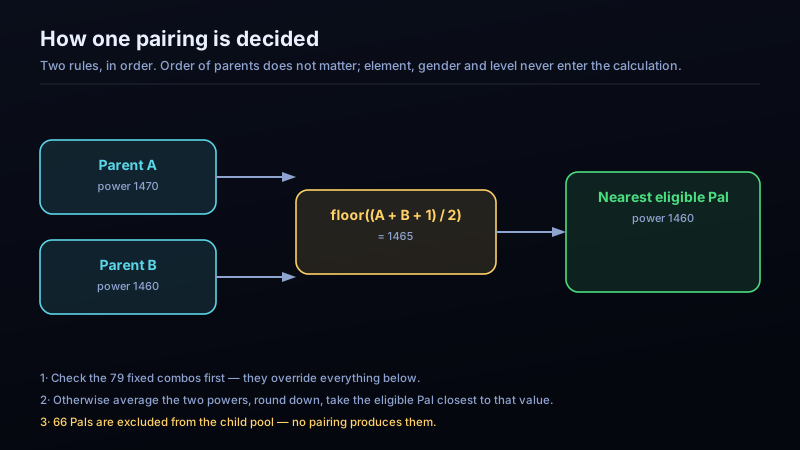
The calculator below does the arithmetic the game does. Give it two Pals and it applies one of two rules, in this order:
- Fixed combo check. 79 named pairs override everything else. Relaxaurus plus Sparkit is always Relaxaurus Lux, whatever the power maths would say.
- Breeding power formula. Otherwise the game averages the two powers and rounds:
target = floor((powerA + powerB + 1) / 2), and the offspring is the Pal whose power is closest to that target. Ties break by Paldex order.
child power = floor((parentA.power + parentB.power + 1) / 2)
Nothing else enters the calculation. Not element, not gender, not level, not which parent is which — the order you pick them in makes no difference to the result.
Three worked examples
Example 1 — two commons. Lamball (power 1470) plus Cattiva (power 1460): target = floor((1470 + 1460 + 1) / 2) = 1465. The closest eligible Pal to 1465 is Cattiva at power 1460. No fixed combo applies, so the formula decides.
Example 2 — a mid pair. Foxparks (1400) plus Sparkit (1410): target = 1405 → Flambelle (power 1405). Same rule, different numbers — the answer is always "whichever Pal sits nearest the midpoint".
Example 3 — where the formula does not apply. Relaxaurus (280) plus Sparkit (1410) would put the target at 845 by the formula, but this pair is on the fixed list: the result is always Relaxaurus Lux. This is the single most common source of "the calculator says something different from my game" — check whether your pair is a named combo before trusting the arithmetic.
The power ladder: reading it without a calculator
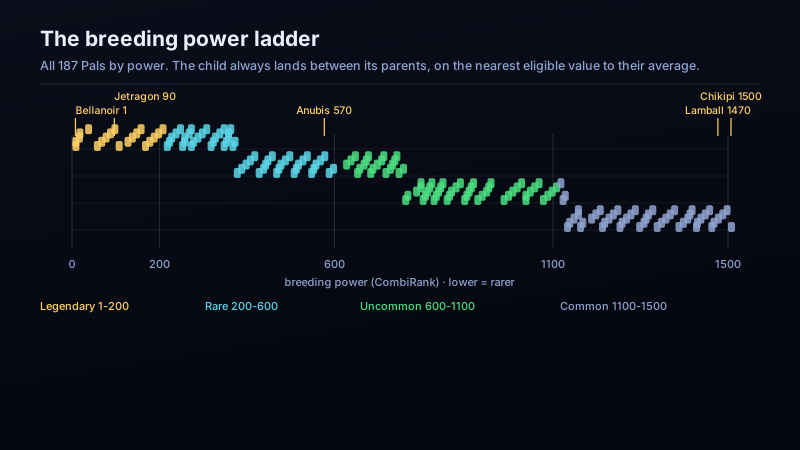
Once you have the ladder, you can reason about breeding without running anything. The rule of thumb is that the child always lands between its parents on the power scale, at the midpoint — so to reach a specific Pal, you want two parents whose powers sit on either side of it, as close together as possible.
| Band | Power range | What lives there | Example |
|---|---|---|---|
| Legendary tier | 1 – 200 | Endgame Pals you catch, not breed | Bellanoir 1 · Jetragon 90 · Frostallion 120 |
| Rare tier | 200 – 600 | Strong mid-game targets | Anubis 570 · Menasting 260 |
| Uncommon tier | 600 – 1100 | The working middle of most breeding chains | Nitewing 420 · Eikthyrdeer 920 |
| Common tier | 1100 – 1500 | Early Pals, easy to catch in bulk | Lamball 1470 · Cattiva 1460 · Chikipi 1500 |
The ladder itself is on this page below the calculator — all 187 Pals in power order, which is the only reference table you actually need if you prefer to do the sum yourself.
Why lower power is better. The scale runs backwards from intuition: the rarer and stronger the Pal, the lower its number. Jetragon sits at 90 while Chikipi is at the top of the common end. So when you are hunting a specific legendary-tier target, you are hunting two parents near the bottom of the ladder, not the top.
Breeding is not free: the Cake cost
Every breeding attempt consumes exactly one Cake, and the Cake is what most players underestimate. Each one needs:
| Ingredient | Amount per Cake | Where it comes from |
|---|---|---|
| Flour | 5 | Grow Wheat, process it in a Mill |
| Red Berries | 8 | Berry Plantation or foraging |
| Milk | 7 | Assign a Mozzarina to a Ranch |
| Eggs | 8 | Assign a Chikipi to a Ranch |
| Honey | 2 | Assign a Beegarde or Elizabee to a Ranch |
The implication for planning: a breeding chain that takes twenty generations takes twenty Cakes. Before you commit to a long chain for a rare passive-skill stack, run the ingredient numbers — the ranch animals to supply Milk and Eggs are usually the bottleneck, not the Pals themselves.
The fixed combination list
These 79 pairs bypass the formula. If your two parents appear here, the result is printed below no matter what their powers are.
| Parent A | Parent B | Offspring |
|---|---|---|
| Flambelle | Fuack | Fuack Ignis |
| Celaray | Univolt | Celaray Lux |
| Bushi Noct | Croajiro | Croajiro Noct |
| Jolthog | Pengullet | Jolthog Cryst |
| Pengullet | Sparkit | Pengullet Lux |
| Penking | Rayhound | Penking Lux |
| Kingpaca | Reindrix | Kingpaca Cryst |
| Flambelle | Tanzee | Tanzee Ignis |
| Mau | Pengullet | Mau Cryst |
| Foxcicle | Foxparks | Foxparks Cryst |
| Killamari | Ribbuny | Killamari Primo |
| Eikthyrdeer | Hangyu | Eikthyrdeer Terra |
| Caprity | Tarantriss | Caprity Noct |
| Digtoise | Turtacle | Turtacle Terra |
| Hangyu | Swee | Hangyu Cryst |
| Kikit | Woolipop | Woolipop Terra |
| Azurobe | Frostplume | Azurobe Cryst |
| Bristla | Ribbuny | Ribbuny Botan |
| Gloopie | Valentail | Gloopie Primo |
| Frostplume | Univolt | Univolt Cryst |
| Gobfin | Rooby | Gobfin Ignis |
| Loupmoon | Sweepa | Loupmoon Cryst |
| Elphidran | Surfent | Elphidran Aqua |
| Foxcicle | Vanwyrm | Vanwyrm Cryst |
| Polapup | Surfent Terra | Polapup Terra |
| Flambelle | Leezpunk | Leezpunk Ignis |
| Gorirat | Kikit | Gorirat Terra |
| Dumud | Surfent | Surfent Terra |
| Fuddler | Robinquill | Robinquill Terra |
| Katress (M) | Wixen (F) | Wixen Noct |
Showing 30 of 79. The calculator above covers the full list — including the pairs that produce variants like Cryst, Lux, Ignis, Noct, Aqua and Terra forms that are otherwise unobtainable.
Pals that cannot be bred
66 of the 187 Pals in the table are excluded from breeding results. Put any two parents together and you will never get one — they have to be caught in the wild, found in a specific location, or defeated as a boss. The calculator flags this: if you reverse-lookup one of these Pals, it tells you outright rather than showing an empty result.
This is the second-most-common source of confusion after fixed combos. Two players can breed what looks like the same pair and get different results simply because one target sits in the excluded group.
Planning a chain, step by step
Most wasted breeding time comes from starting with the parents instead of the target. The order that actually works:
- Name the Pal you want and look up its breeding power. Everything else follows from that single number.
- Run the reverse lookup on this page. It returns every parent pair that reaches your target, with the fixed combos listed separately — so you can see immediately whether there is a shortcut.
- Prefer parents whose powers sit closest together. A pair at 1460 and 1470 leaves almost no room for the result to land anywhere except between them; a pair at 200 and 1400 gives the average plenty of room to miss.
- Check availability, not just arithmetic. The mathematically perfect pair is useless if one parent is a legendary-tier Pal you cannot catch yet. Sort the returned pairs by how realistic each one is for your current save.
- Count the Cakes. One attempt is one Cake, and a chain to stack four passive skills runs into double figures. Work out whether your ranch production actually supports the plan before you start.
The shortcut worth knowing. If you already own a Pal of the species you want, breeding it with itself always produces that species — no lookup, no formula, no risk. That is the standard way to preserve a good passive-skill stack once you have one, and it is why experienced players keep a breeding pair of every species they care about.
Passive skills are the part the formula cannot give you
Species is fully deterministic; passive skills are not. Each parent contributes from its own pool at random, so the way to build a Pal with four good passives is generational: catch a Pal carrying one desirable skill, breed it with a Pal carrying a different one, keep the offspring that inherited both, and repeat until the stack is four deep — then breed that bloodline into the species you actually want.
Practically, that means the calculator answers "which Pal comes out" and your breeding plan answers "which Pals are worth putting in". Both matter, and the second one is where the Cake cost lands.
Sources and standards
Where these figures come from
Every breeding power and every fixed combination on this page comes from the official Palworld wiki's breeding table, re-fetched on 2026-09-23. The calculator runs entirely in your browser — no data is sent anywhere.
- Palworld Wiki — Breeding — breeding power values for all 187 Pals and the 79 fixed combos.
- Pocketpair — developer, for version and patch information.
Figures, formulas and reference tables last verified: 23 September 2026.
This tool is part of the Palworld hub, which covers breeding, the power ladder and the fixed combination list.


