Spring: parsnip momentum, then cauliflower
Spring one starts you with 15 parsnip seeds and almost no capital — plant them all, sell everything, and buy potatoes as soon as you can afford them. The real spring money is strawberries at the Egg Festival on day 13: every gold piece you've scraped together (including fishing income) should become strawberry seeds, because they regrow every 4 days and still pay for themselves twice over before summer.
Summer: blueberries are the year-one engine
Blueberries cost 80g, regrow every 4 days, and drop three berries per harvest — over a full summer one bush out-earns almost anything else you can plant that early. Plant them the moment summer starts. Add a few melon blocks for the quality-crop bundles, and save a patch for starfruit only if the Oasis bus is running.
Fall: cranberries in bulk, one pumpkin patch
Cranberries follow the blueberry playbook (regrower, multi-berry) and pumpkin is the single-harvest heavy hitter for bundles and gifts. If any ancient fruit seeds have come out of your seed maker or traveling cart, fall is when a mature ancient fruit field starts paying 550g every 7 days forever — protect those plants with your life.
Winter: the money comes from mining
Nothing grows, so winter income is the geode-cracking, floor-descending grind plus artisan goods aging in your jars and kegs. Whatever spring two buys with that money — starfruit fields and more ancient fruit — is where the calculator above starts showing numbers that look like typos.
The profit chain has four stages, not one
Most "most profitable crop" lists answer a narrower question than the one players are actually asking. A crop's sell price is only the first of four stages its value passes through, and each stage multiplies the one before it:
- Raw crop — whatever you get for the harvest, modified by quality stars.
- Artisan goods — keg or preserves jar, multiplying base value by a fixed factor.
- Cask ageing — wine only, and only in the cellar, lifting a bottle from silver through gold to iridium quality.
- Time — the stage most guides ignore. A 3× multiplier that takes seven days is not the same asset as a 2× multiplier that takes three.
Getting to stage two doubles most crops. Getting to stage four — thinking in gold per machine per day rather than gold per item — changes which machine you should be building. That distinction is worked through in full on our keg versus preserves jar page; this page covers stages one and four across the whole farm.
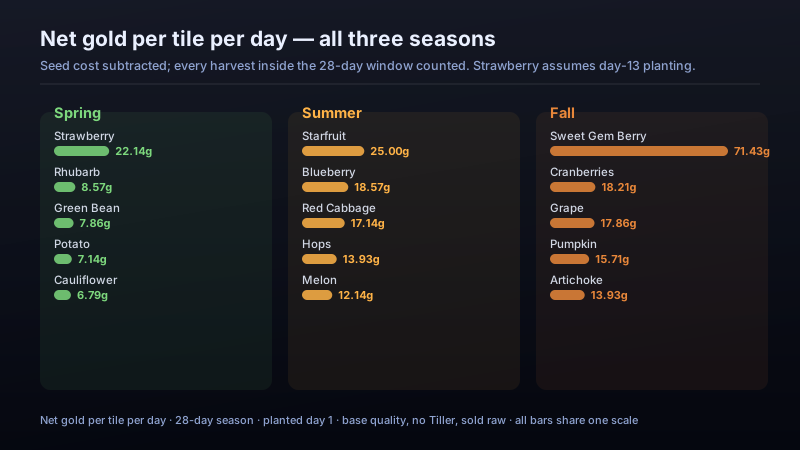
Net gold per day, not gross gold
The number that decides whether a crop is worth a tile is net — after seed cost — divided by the days the tile is committed. Two rules keep the arithmetic honest:
net gold per tile per day = ( Σ harvests × sale value − seed cost × plantings ) / 28
- Charge the seed every time you plant it. A non-regrowing crop you replant pays again; a regrowing crop pays once and harvests for the rest of the season.
- Count only harvests that fit. A 13-day crop planted on day 20 never pays back, however good its sell price looks.
| Season | Crop | Seed | First harvest | Regrowth | Harvests | Net per tile | Gold/tile/day |
|---|---|---|---|---|---|---|---|
| Spring | Strawberry | 100g | 8 days | every 4 days | 6 | 620g | 22.14 |
| Spring | Rhubarb | 100g | 13 days | none | 2 | 240g | 8.57 |
| Spring | Green Bean | 60g | 10 days | every 3 days | 7 | 220g | 7.86 |
| Spring | Potato | 50g | 6 days | none | 4 | 200g | 7.14 |
| Spring | Cauliflower | 80g | 12 days | none | 2 | 190g | 6.79 |
| Summer | Starfruit | 400g | 13 days | none | 2 | 700g | 25.00 |
| Summer | Blueberry | 80g | 13 days | every 4 days | 4 (3 berries each) | 520g | 18.57 |
| Summer | Red Cabbage | 100g | 9 days | none | 3 | 480g | 17.14 |
| Summer | Hops | 60g | 11 days | daily | 18 | 390g | 13.93 |
| Summer | Melon | 80g | 12 days | none | 2 | 340g | 12.14 |
| Fall | Sweet Gem Berry | 1,000g | 24 days | none | 1 | 2,000g | 71.43 |
| Fall | Cranberries | 240g | 7 days | every 5 days | 5 (2 berries each) | 510g | 18.21 |
| Fall | Grape | 60g | 10 days | every 3 days | 7 | 500g | 17.86 |
| Fall | Pumpkin | 100g | 13 days | none | 2 | 440g | 15.71 |
| Fall | Artichoke | 30g | 8 days | none | 3 | 390g | 13.93 |
Read the table column by column rather than row by row. Sweet Gem Berry wins by a factor of three and it is not close — but Rare Seeds come from the Traveling Cart at 1,000g each and stock is limited, so it can never be your whole farm. Ignoring it, Strawberry, Starfruit and Cranberries cluster between 18 and 25 g/day, and that cluster is what a normal farm actually runs on.
Three worked examples
Strawberry, spring. Matures in 8 days and regrows every 4. Planted on day 1 that is harvests on days 8, 12, 16, 20, 24 and 28 — six pickups of 120g = 720g, minus one 100g seed = 620g net, 22.14 g/day. The catch is that seeds only come from the Egg Festival on Spring 13, so a realistic first spring plants on day 13 and gets fewer harvests. Buy as many as you can afford on the 13th and save the rest of the seed for year two.
Starfruit, summer. 400g seed, 13 days to maturity, does not regrow. Two plantings fit in 28 days: days 13 and 26. Gross 1,500g minus 800g of seed = 700g net, 25.00 g/day. It is the best repeatable raw number in the game and the worst cash-flow crop in it, because you spend 800g per tile before the first fruit is picked.
Cranberries, fall. Matures day 7, regrows every 5 days, and yields two berries per harvest at 75g each. Harvests land on days 7, 12, 17, 22 and 27: five pickups × 2 berries = 10 berries × 75g = 750g, minus 240g of seed = 510g net, 18.21 g/day. The double yield is what makes cranberries the fall workhorse — the per-berry price is unremarkable.
What changes once processing enters
Raw gold per day is the right metric when you have no machines. With machines in the picture the ranking shifts, because processing multiplies base value without consuming another tile — only machine time.
| Crop | Raw g/tile/day | Best machine | Product | Value from 1 unit |
|---|---|---|---|---|
| Starfruit | 25.00 | Keg | Wine | 2,250g |
| Ancient Fruit | — (greenhouse) | Keg | Wine | 1,650g |
| Pumpkin | 15.71 | Preserves Jar | Pickles | 690g |
| Cranberries | 18.21 | Preserves Jar | Jelly | 200g per berry |
| Blueberry | 18.57 | Preserves Jar | Jelly | 150g per berry |
The pattern is that processing rewards high base value and punishes nothing else — the multiplier applies to the crop, so a 750g starfruit gains 1,500g while a 50g blueberry gains 100g. That is exactly why the machine choice stops being obvious, and why it gets its own page.
The four mistakes that cost the most gold
- Planting late. A blueberry planted on day 1 returns 520g a tile; planted on day 14 it returns 220g for the same 80g seed. No crop choice recovers a missed start.
- Comparing gross prices. Melon sells for five times a blueberry and still loses on gold per day, because it pays once instead of across four pickups.
- Ignoring machine throughput. A cellar full of kegs is a bottleneck the moment your harvests outpace it. Once that happens, crop choice should follow machine time, not gold per item.
- Treating a seasonal ranking as permanent. Rankings assume base quality with no fertiliser and no Tiller. Quality fertiliser, Speed-Gro and the Tiller profession all shift the numbers — recompute for your own farm before committing a whole field.
A full Stardew year at the desk
A first-year plan is a season-by-season schedule you check as the days tick by, so the sessions run long and relaxed. These are the items that suit slow farming play.
- PC game controller — Stardew is comfortable on mouse and keyboard, but a long, unhurried session is easier on a gamepad.
- Planner notebook — A season plan with planting dates and profit per day is the kind of thing you scribble beside you and refer to daily.
- Gaming mouse — Fishing and inventory work both live on the mouse; a comfortable one matters across a full in-game year.
- Gaming headset — The soundtrack is half the appeal; a headset keeps it close without taking over the room.
As an Amazon Associate I earn from qualifying purchases. The links above are affiliate links — if you buy through one, the price you pay is unchanged and a small commission helps keep these calculators free. Tools are listed because the job calls for them, not because of commission rates.
Sources and standards
Where these figures come from
Every formula on this page is implemented from the published reference material below. Where a value depends on a regional code, the calculator lets you override it rather than assuming one jurisdiction.
- Stardew Valley — official site — the game of record; version notes and feature announcements come from here.
- ConcernedApe — the developer, and the authority on balance changes between updates.
Figures, formulas and reference tables last verified: 23 September 2026